
Spokane City Directory Collections
Spokane's historical shelf is not one unbroken set. The Spokane Public Library genealogy collection identifies R.L. Polk & Co. volumes and other local history tools at Central Library. The Washington State Library lists longer runs, but those holdings contain gaps and overlaps that must be checked volume by volume. Online access is narrower. The Washington Digital Archives presents a small early group as a searchable series, while later books remain tied to physical volumes, catalog records, licensed databases, or staff help.
| Collection | Years | Where Held | Access |
|---|---|---|---|
| R.L. Polk Spokane volumes | Spokane examples from 1885 through 2025, with gaps | Spokane Public Library | Spokane catalog and physical volumes |
| State Library Spokane runs | Selected Spokane years, 1892 through 2013 | Washington State Library | Limited Spokane appointment access |
| Digitized R.L. Polk series | Spokane titles for 1890, 1892-93, 1896 | Washington Digital Archives | Free Spokane search and browse |
| Hillyard editions | Spokane-area years 1897-1905, 1907-1924 | Washington State Library | Check the Spokane edition and reel |
| Suburban and Valley editions | Selected Spokane-area years, 1956-2013 | State and local library holdings | Spokane catalog or staff confirmation |
| Reverse and telephone books | Exact Spokane reverse years not confirmed | Spokane Central Library special collections | Ask Spokane staff by year and call number |
The Spokane catalog names volumes for 1885, 1887 through 1890, selected late twentieth-century years, 2010, and 2023 through 2025. That is Spokane holdings evidence, not proof of a full run. State listings fill many Spokane years yet use overlapping entries. Record the exact Spokane title, year, publisher, call number, and page rather than turning broad catalog spans into a false claim of complete coverage.
Spokane City Directory Research Desk
Inland Northwest Special Collections sits on the third floor of Spokane's Central Library. The desk can be reached at 509-444-5338 or specialcollections@spokanelibrary.org. Ask for the directory year, publisher, format, and Northwest Room call number before a visit. Staff can also point to obituary indexes, census microfilm, county plat maps, Sanborn maps, early newspaper indexes, and long runs of Spokane newspaper film.
Spokane library-computer access adds useful sources. Ancestry Library Edition, FamilySearch affiliate access, Newspapers.com, and ProQuest Historical Newspapers may expose Spokane items unavailable from home. The library says its affiliate computers unlock nearly 90 percent of restricted FamilySearch material. For a remote Spokane request, send name variants, an approximate year, street or neighborhood, and the kind of record sought. A tight request makes both a match and a no-match reply far more useful.
The library's genealogy page shows the research setting captured below.
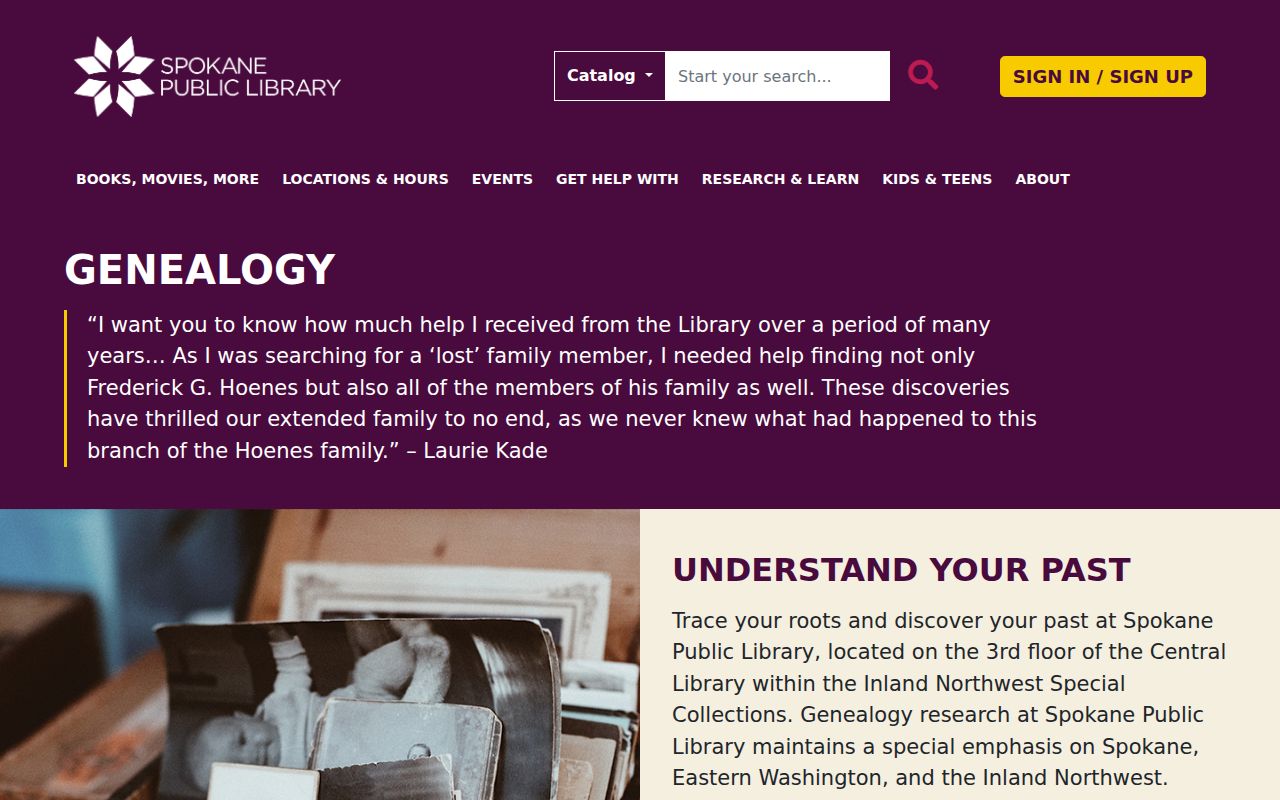
Use the desk as a route into the right year and format, especially when a catalog record does not show whether a volume has an address section.
Search Spokane City Directories Online
The Washington Digital Archives directory series holds 44,976 volunteer-indexed records from the digitized 1890, 1892-93, and 1896 R.L. Polk titles. Search fields are Party Last, Party First, Party Middle, and Soundex. Soundex groups names by how they sound, which can catch a spelling shift. The Browse control helps when a surname was read or keyed in an unexpected way.
The Spokane collection description separates Spokane Falls for 1880 through 1891 from Spokane from 1891 forward. Preserve the Spokane label printed in the source. A person present before the Spokane city-name change may be missed if only the modern place name is used. Volunteer text is a Spokane index, not the whole entry, so consult the original image or volume when it is available and retain the Spokane page context.
The Digital Archives collection page provides the search and browse route shown here.
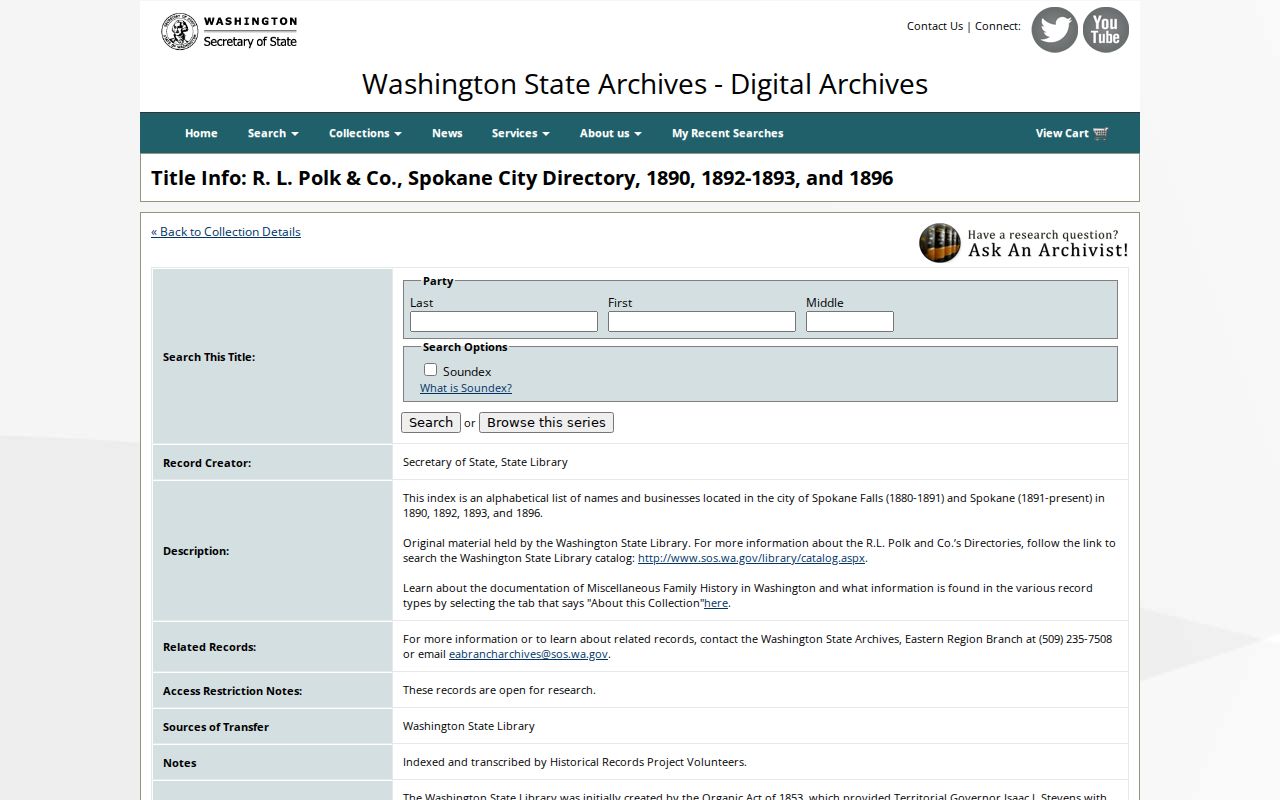
The screen is a strong first stop for the digitized years, but it does not stand for all Spokane directory volumes.
Spokane City Directory Geography
A missing Spokane result may be a geography problem. Hillyard has separate State Library runs for 1897-1905 and 1907-1924. Selected suburban editions span 1956-2000, suburban northwest and southeast editions cover selected 2001-2013 years, and Spokane Valley has separate listed volumes for 2006 and 2008-09. A present-day Spokane mailing line does not prove that the old publisher filed the same address under the city heading.
Search the central Spokane edition first, then the Hillyard or suburban run that fits the address and year. Compare the old street spelling and local place label with maps from the same era. Keep the edition's own geography in the citation. This prevents a suburban hit from being treated as if it came from the main city volume.
Note: Confirm the actual volume before concluding that a blank year means the person had left Spokane.
Decode Spokane City Directory Entries
An entry is an annual clue, not a full biography. The local R.L. Polk runs may include a name, spouse notation, trade, business, street address, room or apartment, widow notation, and ownership or household marks. Fields vary by year. Read the key printed in that exact volume before expanding any short form, and never assume every edition uses the same marks.
| Name | Listed person and, in some editions, a spouse or relationship notation |
|---|---|
| Trade or business | Work or firm clue, subject to the year's printed format |
| Address | House number, street, and sometimes an apartment, room, or business site |
| Household mark | Owner, renter, or householder notation only when the volume key confirms it |
| Widow notation | A clue to search death, obituary, probate, and nearby directory years |
- Criss-cross directory
- An address-ordered section that leads from a street and house number to the listed occupant or account.
- Householder index
- A list centered on the person responsible for a household entry, not a list of every person there.
- Abbreviation key
- The edition's own legend for short forms and symbols. Save it with the entry page.
A directory address does not prove title. Check ownership in the Assessor or Recorder records. It also does not prove that every family member was present. Use a dated census, newspaper, obituary, or vital record to test relationships. The printed entry narrows the time and place so those checks can be precise.
Reverse Spokane City Directory Searches
Later reverse or criss-cross books change the question from “where did this name live?” to “what listing appeared at this address?” Spokane Library's directory shelf is the known local route, but exact reverse-edition years were not confirmed in the research. Ask Northwest Room staff to distinguish an ordinary alphabetical Polk volume from an address-keyed section for the year in question.
Start with the Spokane street, then house number, and copy the Spokane edition year plus every field shown. Telephone and business entries can share a Spokane address, and one structure can hold several units. If no reverse section exists, use an alphabetical name search, a Spokane period map, and the modern Spokane street directory workflow as separate checks. Do not read a missing Spokane line as proof that a home stood empty.
Spokane Names Beyond Directories
The regional obituary directory contains more than 100,000 notices from the early 1900s onward. It points to a publication and Central Library location rather than always supplying the full notice. Follow that pointer to newspaper film. Spokane Library also holds more than 200 high-school yearbooks from 1911-1977, useful for a former classmate or family trail. A yearbook is a school-year snapshot, not a current address source.
Newspaper coverage includes film for 1882-1894 and 1895 to the present, plus licensed historical runs. Photos and vertical files can tie a name to a building, group, or street. Save captions and source notes. These companion sources help explain why a directory line changed, but they should be cited on their own terms.
Spokane Directory Time Markers
Several dates explain the collection's shape. They also show why one modern search box cannot cover Spokane's full record past.
| Year | Directory and records context |
|---|---|
| 1858 | Spokane County was created, before later merger and re-creation. |
| 1879 | Spokane County was re-created after its period with Stevens County. |
| 1880-1891 | The Digital Archives description uses the Spokane Falls label. |
| 1891 onward | The same description uses Spokane as the city label. |
| 1890 | A directory helps bridge the federal census schedule lost in the 1921 fire. |
| July 2025 | State Library public access changed to limited appointment hours. |
The courthouse completed in 1895 and the changing county labels matter for other record groups, too. When a city directory points to probate, deeds, or naturalization, search the office and place names used in that period. A blank modern index may reflect custody or labeling rather than a missing person.
Trace Families in Spokane Directories
Build the trail one year at a time. Directory names may be shortened, streets may be filed in an older form, and a family can appear under more than one edition area. Keep each original spelling. Pair the annual evidence with federal census snapshots, which are generally released after 72 years. The 1950 census is the latest public decennial census in 2026.
- Write down the full name, variants, exact address, and first confirmed directory year.
- Check the year before and after. Note each shift in street, spouse notation, trade, or business.
- Use an address section when the edition has one, then compare nearby names and unit numbers.
- Match the 1910, 1920, 1930, 1940, or 1950 directory evidence to the census year and district.
- Test a disappearance with newspapers, the obituary index, probate, property records, and vital indexes.
- If the volume is missing, contact Spokane Library, the State Library, or the Eastern Archives branch with the exact year.
The destroyed 1890 federal population schedules make Spokane's 1890 directory, Sanborn maps, and newspapers especially useful. A person who vanishes may have moved, died, gone unlisted, or fallen into a gap in the shelf. Only a second dated source can sort those paths. For modern confirmation after a historical find, use the Spokane resident lookup steps without assuming that two people with the same name are one person.
Test Spokane Addresses on Maps
Sanborn fire-insurance maps describe lots, building footprints, uses, and hazards. They do not name every occupant. Spokane coverage starts with initial blocks in 1884, followed by a full 1891 set, 1902, 1910, a 1925 update, 1950, and portions updated into 1965. Use the map to test whether a building and street number existed in the directory year.
The Spokane Library house-history guide combines maps, directories, permits, news, and parcel clues. Start with the address and legal parcel, find the right map sheet, then return to the directory name. This two-way check is strong when a street number changed or a directory line is hard to read.
The Historic Spokane property research page is captured below as another route into local sources.
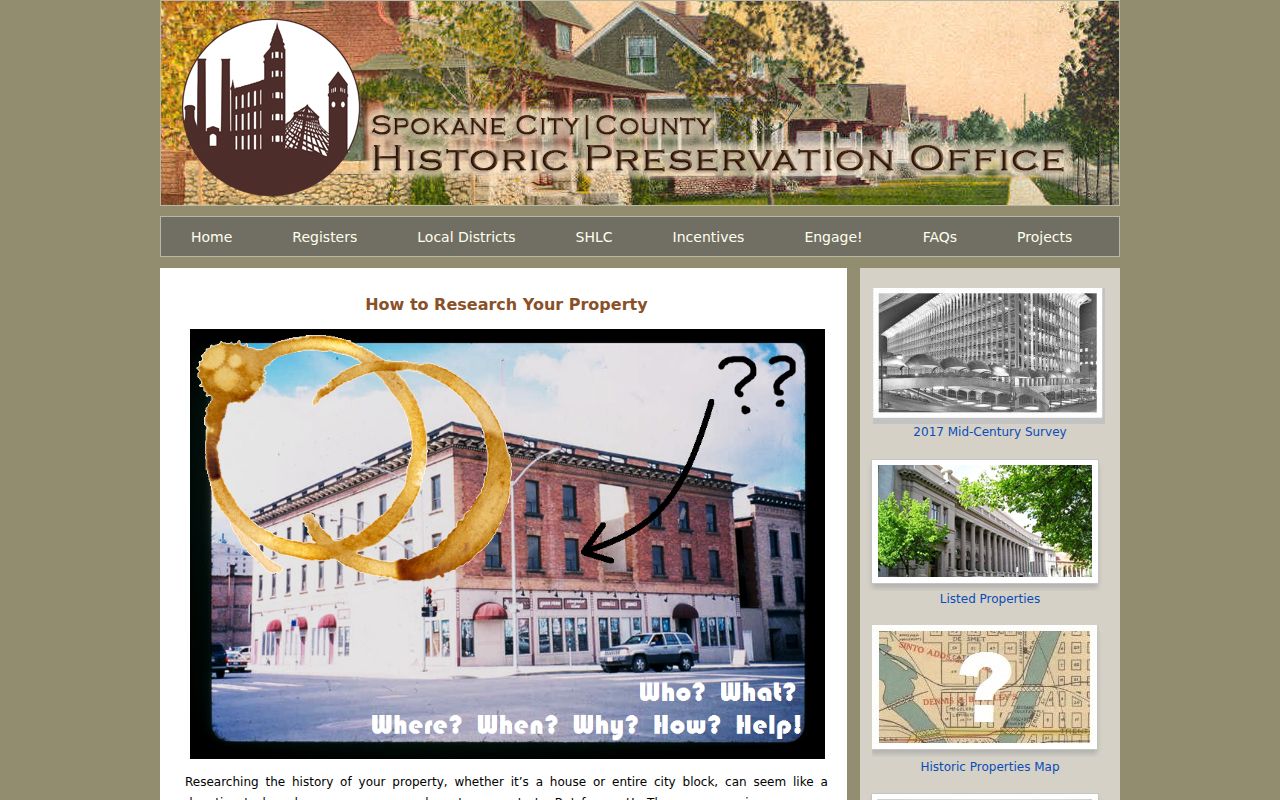
The local source list helps connect a directory citation to a real building and era without treating a map as an occupant roll.